
Creator Percolator
At the intersection of creativity and infrastructure.
Issue #2 — About the Beehiiv Winter Release; Substack Cultural Divides
In this issue, a look at what the Beehiiv Winter Release does and doesn’t mean. But first, a recap of tool and platform updates outside the hiiv.
Creator Tools Watch
1. Kit creator-platform evolution
Kit (previously ConvertKit) has expanded its positioning to become a “creator-first email marketing & growth platform” with integrated commerce, landing pages, and digital product support.
Why it matters: As we’ll see later in the issue, Beehiiv presented themselves as more or less having invented the wheel for creators. But Kit already had a lot of the same stuff (and a very interesting “Kit App Store” as well. More to come.
2. Ghost integrations ecosystem growth
Same thing for Ghost, though with slightly different components. They’ve got a sexy analytics dashboard, too. And paid memberships.
Why it matters: Signals that even “open” publishing systems are trending toward flexible, connected stacks—not silo-platforms.
3. YouTube’s AI-powered creator tools
YouTube announced a new suite of creator features: including AI video-editing (e.g., transform raw footage into first-draft cuts), auto-dubbing/multilingual video support, improved collaboration tools, and new comment-moderation & brand-collaboration workflows.
Why it matters: Video creators now have more platform-native automation and production aid—raising the stakes for how easy it is to build and distribute video-first creator work.
About that Beehiiv Winter Release
Big, Bold, and Possibly a Trap
Beehiiv didn’t just announce “winter updates.”
They announced a worldview. They went ever so “Apple Announcement Event” on their presentation (minus the flourishes that cost the big money, and I certainly can’t fault them for that). Interestingly, something on the order of a thousand folks showed up live (by my check of the counter mid-presentation). And those who were chatting were uniformly hyped up (with the occasional note of caution).
The announcements that were really new and actually available here and now were:
- An AI interface for their website builder. Best thing about it, you can use it as a regular drag-and-drop interface at any point in your iterations with AI. This is an excellent move.
- Support for selling digital products. I suspect some of the folks in the chat saw it as a “Gumroad Killer,” but I doubt it’s that decisive a stroke. There’s something about starting simply and making small bets by just selling one small thing (the premise of Gumroad) that will continue to be attractive—all the more so as Beehiiv inevitably becomes more and more complex.
- Analytics. It looks like all the other Material UI-inspired dashboards out there, which is to say it looks pretty nice, but I can’t tell you yet whether it provides the detail and subtlety that making stats into something actionable with require.
- A refresh to the controls advertisers on the Beehiiv ad network use. Some interesting new capabilities added and this is one area where Beehiiv has an arguably unique play.
They are attempting to become the operating system for your entire creative business.
Beehiiv Wants to Own the Creator Stack
Creators often imagine platforms as toolboxes. Platforms imagine creators as ecosystems.
Beehiiv is now making the same bet Shopify made a decade ago:
If we can centralize publishing, payments, pages, products, analytics, and audience we own the gravitational center of the modern creator.
From a business perspective, it’s brilliant.
From a creator perspective?
It depends how much of your business you’re willing to hand over.
Let’s give credit where it’s due:
1. They’re solving the “sprawl problem.”
Creators today juggle as many as a dozen different tools.
Beehiiv is saying: What if we just handled all of it?
2. They executed fast and cohesively.
Most platforms ship features like puzzle pieces, delivering piece by piece and without necessarily making it clear where the piece is supposed to fit into the larger picture.
Beehiiv shipped a coherent thesis about the future.
3. They’re attacking the right friction points:
- fragmented analytics
- scattered publishing
- weak landing pages
- platform fees
- fragile third-party automations
- product sales that require external systems
This was a strategically ruthless update—ruthless in the best way.
4. They offered creators a promise:
“You can build your whole business here.”
And that’s the part that should make you sit up straight.
Here’s the Other Side of that Coin:
Every “all-in-one tool” eventually becomes a “locked-in-one tool.”
It’s not intentional, exactly. It’s structurally inherent.
The more your business depends on a single platform, the more that platform becomes your business.
This is the danger side of the ambition.
Conclusionwise, if you’re just getting started, Beehiiv is an easy way to get your infrastructure (including payment handling) in place within an afternoon. Otherwise, and to the extent that you’re planning ahead, you’ll want to think about how you’re going to handle future offerings. Will you use a best-of-breed, narrowly focused podcast service or will Beehiiv’s version be good enough for what you’re doing. It’s hard to plan ahead, of course, so the real trick is to have a plan for having sufficient options to meet the needs of future days when they arrive.
Meanwhile on Substack…
There are definitely a number of changes in what I suppose I’d call the “culture” of Substack that are gaining speed and momentum right now.
Before talking about those changes, it’s worth underscoring that perhaps the most interesting thing about Substack is that it has a culture. Unlike other platforms (including Beehiiv), Substack publishers and readers are aware of and interacting with other people on the platform. That’s made for enhanced discoverability for newsletterists, but it also has created a clash of ideals among users.
The original writers drawn to Substack were drawn by the opportunity of a venue where long-form writing was the norm. They wanted writing that tackled its subjects in a slower and more thoughtful way. And they wanted a place where writers of longer pieces that inherently take longer to write could be financially rewarded through paid subscriptions.
In April of 2023, Substack introduced a Notes feature that essentially created an internal “slow Twitter.” It was a stream of short content, but not constrained by the character limits of Twitter and, simply because it had a much smaller group of participants, it literally scrolled more slowly. And it wasn’t driven by algorithms in the same way as most social media these days.
When I spoke with a twenty-something newsletterist a couple weeks ago, one thing she shared with me caught my attention. Most of her friends, she said, really liked the Notes stream. I hadn’t really expected that and its something to take note of (so to speak). They liked it for all the right reasons, I’d say, at least according to her.
But people are increasingly trying to game and leverage the Notes stream. As I write this, the first sixteen Notes coming up for me are in one way or another about making money by piling up readers and paid subscribers. Possibly it’s because I’ve done something to tilt some kind of algorithm in that direction, but then again I doubt it. I could dilute the drivel a bit by following people who simply don’t write those kinds of notes, but the underlying point is wonderfully captured by camden noir:
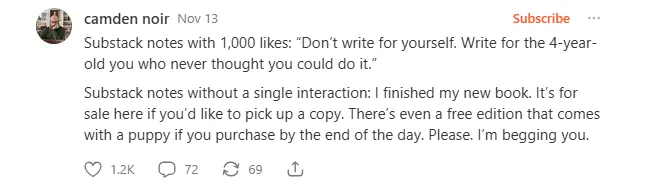
So on the one hand you’ve got the “slow and long” camp of original adopters of Substack. On the other hand you’ve got people hoping they can jump on changes in Substack where they were “too late” to game the works on X or Instagram.
For good analysis and predictions about changes in Substack and its culture, I heartily recommend The Great Substack Shift by Andi Bitay.
Next week, a look at Ghost’s social posting tools and strategy.
–Robert
Talk to me directly: rlr@peakzebra.com